
Internationalization tab
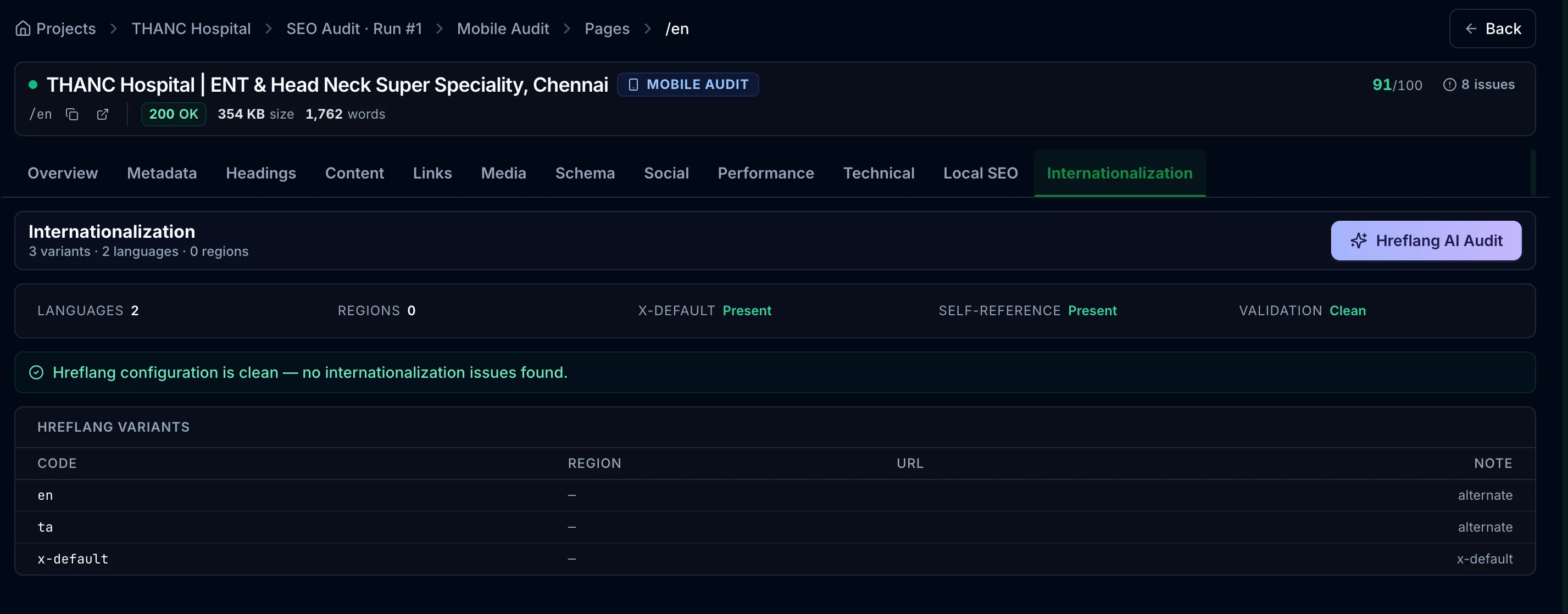
The Internationalization tab validates hreflang — language and region coverage, self-reference, x-default, and the variant list.
The Internationalization tab validates a page's hreflang setup: the tags that tell Google which language and region version to serve to each searcher. Get it wrong and Google may show the English page to French users, split ranking signals across duplicate language variants, or ignore the annotations entirely. The tab renders only when internationalization is enabled for the project. On a monolingual site the checks stay off so they cannot false-positive. To turn them on, use Project Settings → Local SEO.
Coverage
A coverage strip summarizes the setup at a glance: the number of languages and regions declared, whether x-default is present, whether the page self-references, and the validation result — clean, or a count of errors. Any literal hreflang errors are listed explicitly.
Three signals decide whether the setup is valid:
- Self-reference — each page in a language set must include an hreflang tag pointing to itself. A set that omits the self-reference is invalid and Google discards it.
- x-default — the fallback served when no declared language and region matches the user. Recommended for any multi-region site.
- Reciprocity — every variant a page points to should point back. A one-directional annotation is ignored, so reciprocity errors are surfaced here.
Regional language coverage
When the page targets regional variants, a regional languages summary lists the
distinct language bases the crawl detected (for example, en, es, de), so you
can confirm the intended locales are all represented.
Hreflang variants
The variants are shown as a table with columns for the language code, region, URL, and a note marking self, x-default, or alternate. For pages with many variants (more than twelve), the list groups into a per-language accordion instead, with x-default pinned to the top, so a large locale set stays readable.
Hreflang is reciprocal by design. If page A lists page B as its French variant, page B must list page A in return, and both must self-reference. A single missing back-reference invalidates the pairing, which is why the tab reports reciprocity and self-reference as first-class checks rather than footnotes.