Content tab
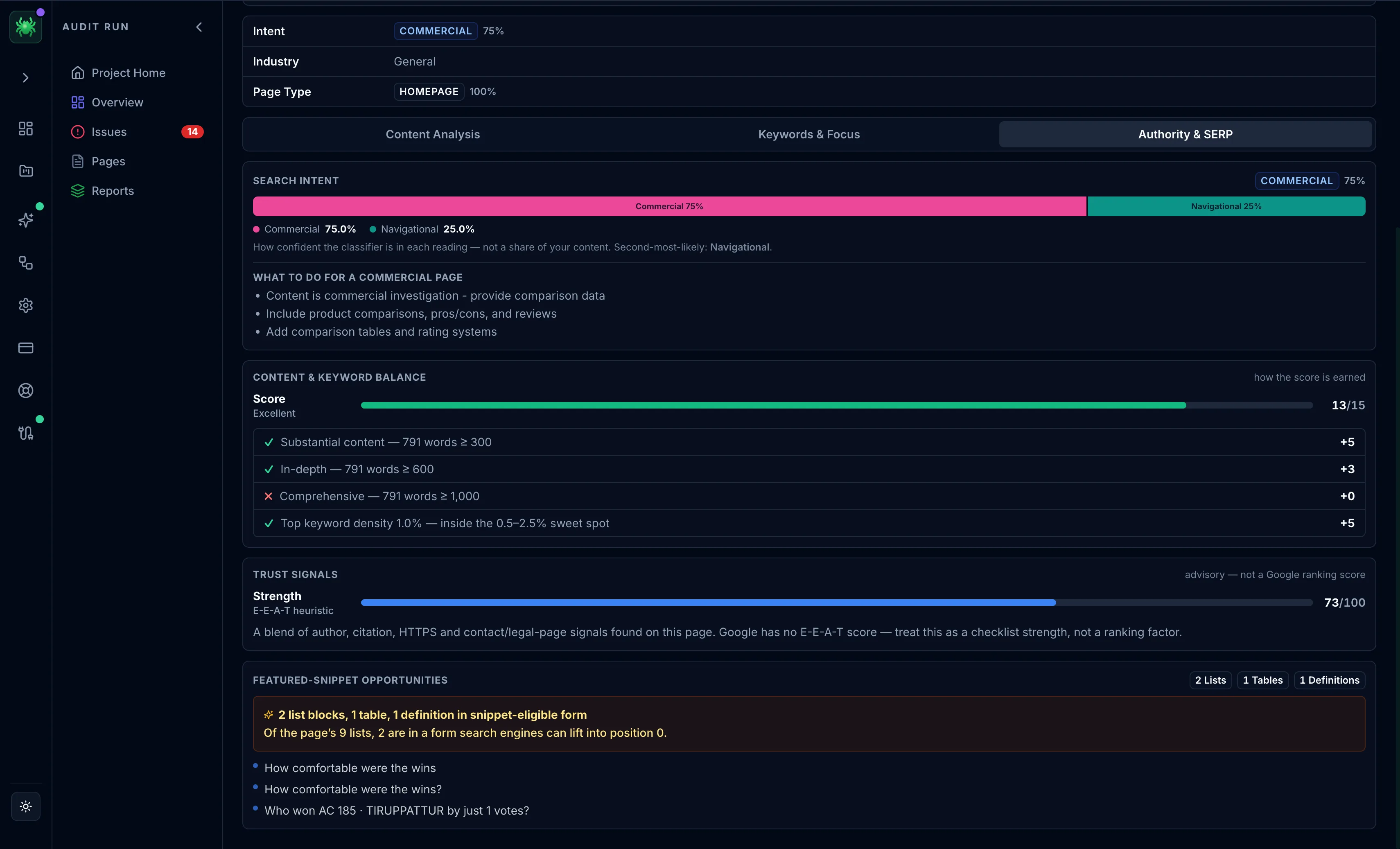
The Content tab measures quality, keywords, and authority across three sub-tabs, with intent and industry detection.
The Content tab assesses how well a page's writing serves its purpose. It checks whether the page reads clearly, targets the right terms, and carries the trust signals Google and AI answer engines reward. A page identity card at the top shows the detected intent, industry, and page type, each with a confidence percentage. That frames the rest of the tab against what the page is actually trying to do. The detail is split across three sub-tabs.
Content analysis
The first sub-tab reports the fundamentals in a metric grid: word count, reading time, paragraph counts, text-to-HTML ratio, readability grade (with the Flesch reading-ease score), vocabulary diversity, passive voice, and maximum keyword density.
- Readability grade — a lower grade reads more broadly; aim to match it to the audience rather than push it as low as possible.
- Text-to-HTML ratio — a very low ratio can signal a thin or heavily templated page.
- Max keyword density — the single most-repeated phrase's share of the text, the early-warning signal for keyword stuffing.
Keywords & focus
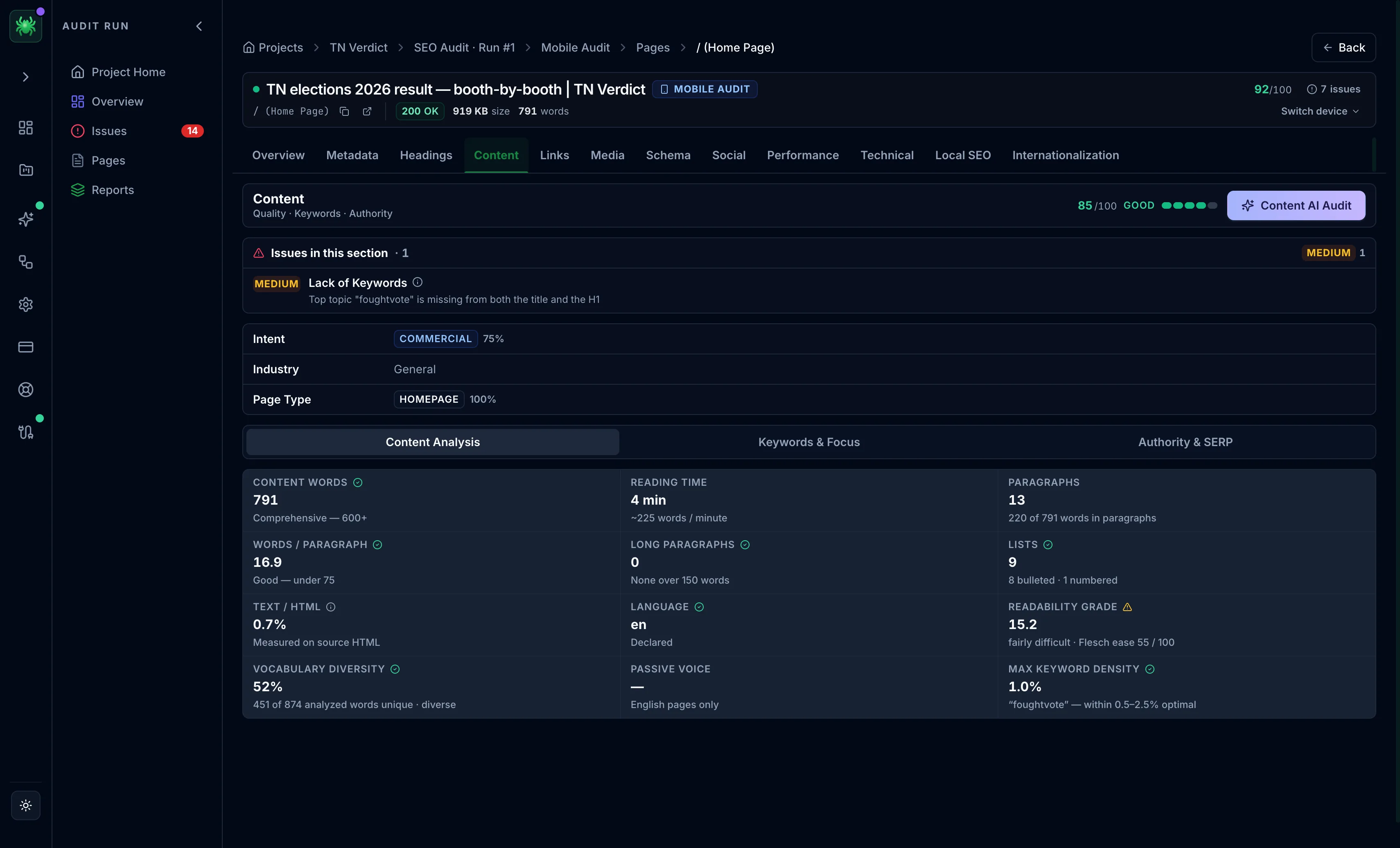
The second sub-tab covers what the page targets:
- Related keywords & entities, and focus keywords drawn from the title and headings
- Keyword density — a table of one-, two-, and three-word phrases with each phrase's share of the analyzed text
- Keyword placement — a matrix of each keyword against the title, meta, URL, and heading levels, flagging over- and under-optimization
- A keyword-stuffing banner when density exceeds the safe threshold
Placement is judged separately from density. A keyword can appear at healthy density yet be missing from the title or H1. The placement matrix is where that gap shows. Closing it usually moves rankings more than adding repetitions.
Authority & SERP
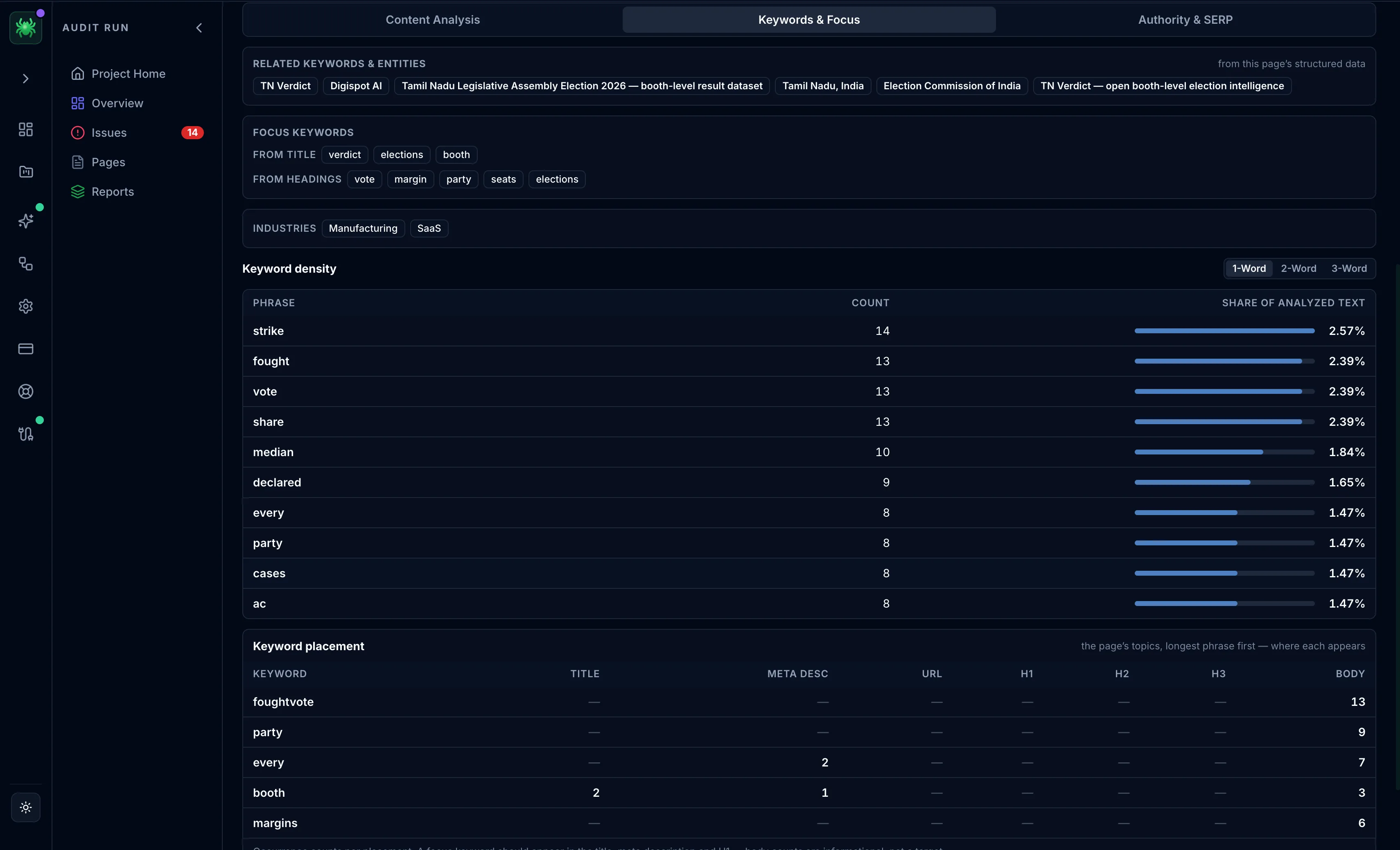
The third sub-tab scores ranking potential. It covers an intent breakdown, a content and keyword balance rubric, trust signals (E-E-A-T: experience, expertise, authoritativeness, trust), and featured-snippet opportunities. Snippet opportunities are the lists, tables, and definitions the page is structured to win. They matter increasingly because the same structured passages that win a featured snippet are what AI answer engines quote.
On paid tiers, the tab's Content AI Audit turns all of this into prioritized recommendations.