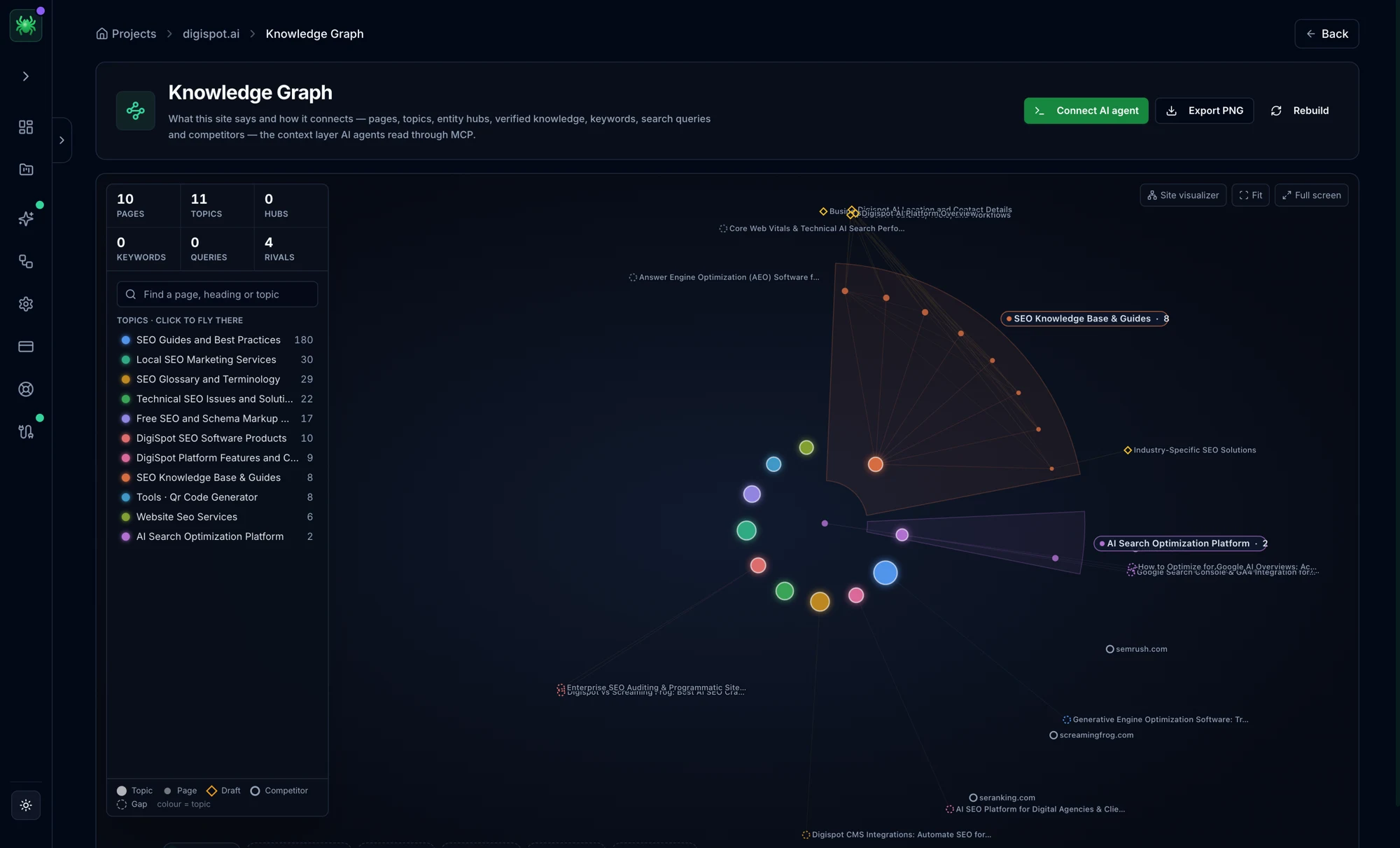
Knowledge graph
A connected map of your site's pages, topics, entities and verified facts. It is the compact context layer AI agents read over the MCP server.
The knowledge graph is a connected map of what your site says. It holds your pages, topics, entity hubs, keywords, search queries, competitors and your verified business facts. It is the context layer AI agents read through the MCP server. An agent works from this structured map instead of re-crawling the site or guessing from raw page text.
The graph is built inside the desktop app. Reading it from an AI agent uses the MCP server, which is available on Tracker and Leader.
What it maps
Every node comes from data the audit already produced:
- Pages, connected by their internal links and sized by inbound links.
- Topics, the clusters your pages fall into, each with its pillar page.
- Entity hubs, the people, places and organizations the site is about.
- Keywords and search queries, mapped onto the pages they target.
- Competitors tracked against the same topics.
- Content gaps, topics the site does not yet cover.
- Verified Knowledge, the business facts you have approved.
How it is built
The graph is assembled from your latest completed audit. Its layout is deterministic, so no AI calls are needed to generate or position it. It rebuilds automatically when the audit or your Knowledge changes. This keeps it fast to produce and inexpensive to keep current.
What an AI agent reads
Over MCP, the graph is served as a single brief. The brief summarizes the whole site in a few hundred lines. An agent reads that summary instead of ingesting a full crawl. Answers stay grounded in real structure, and they cost fewer tokens. Use Connect AI agent on the graph page to point a client at the MCP server.
Grounded in verified facts
The graph reads from your Knowledge store. Every fact carries a reviewed state. AI can propose entries it infers from the site, but a proposal becomes grounding truth only after you approve it. The context stays accurate as it grows.
Closing the gaps
The graph flags topics with no verified knowledge and lists content gaps. These are the places where an AI answer would otherwise guess. From there you produce a fix and apply it yourself. Draft a Knowledge entry, generate a JSON-LD block, or write an MDX page draft.
Fill in Knowledge before relying on the graph over MCP. The more verified facts behind it, the more specific and correct an agent's answers become.