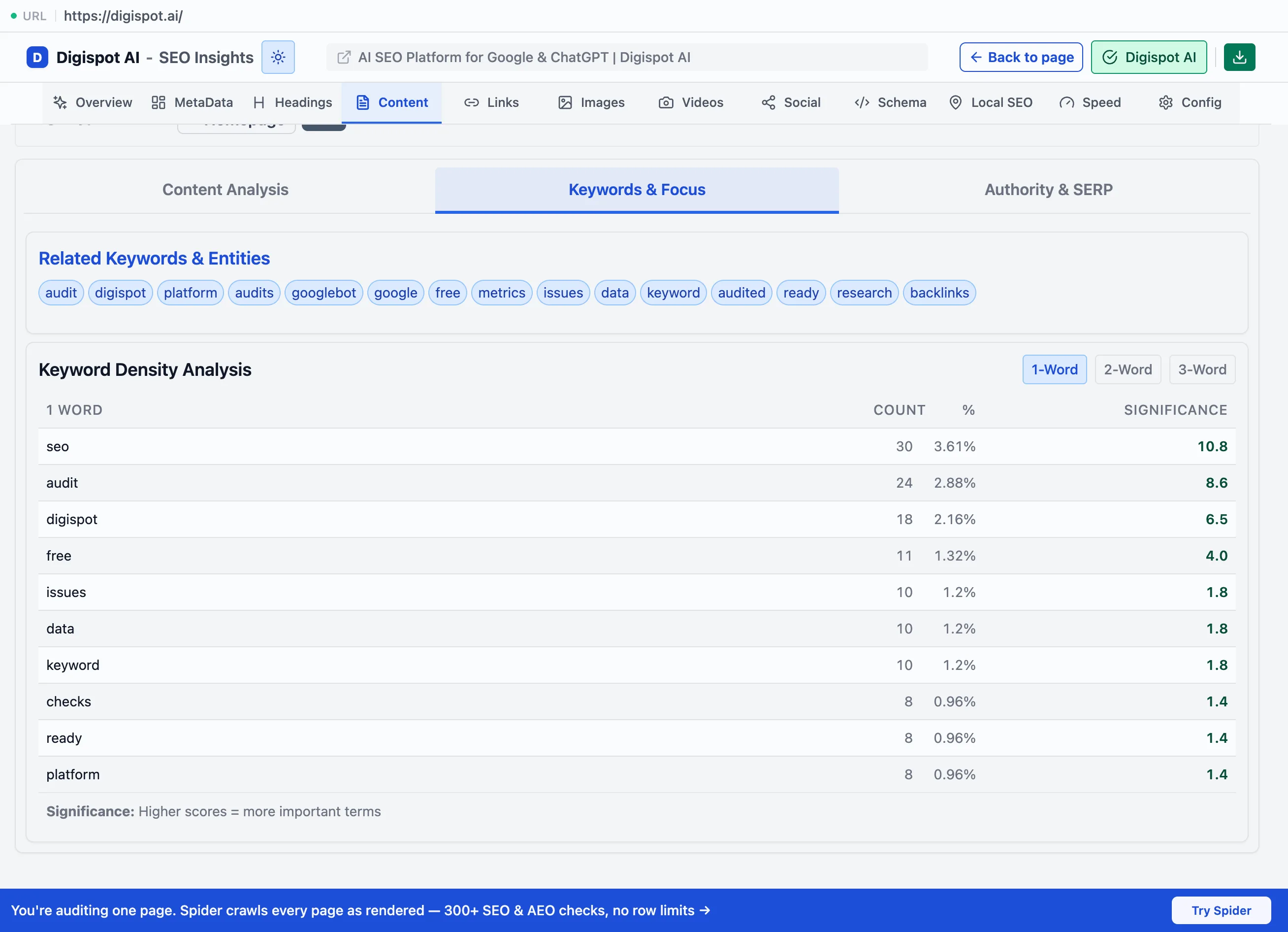
Keywords
The keyword analysis surfaces the terms a page ranks for — density across one-, two-, and three-word phrases, related entities, and authority correlation.
Keyword analysis shows which terms a page actually emphasizes and how they relate to what already ranks. It lives in the Content panel's Keywords & focus sub-tab. It turns the raw text into ranked phrases. This makes the gap between the term a page is meant to rank for and the term it actually reinforces visible, before that gap costs a ranking.
Keyword density
Density is analyzed across unigrams (1-word), bigrams (2-word), and trigrams (3-word) phrases. Each phrase shows its frequency, relevance, and density, so both primary terms and long-tail phrases are visible. Toggle the n-gram length to move between broad head terms (unigrams) and the specific phrases searchers type (bigrams and trigrams).
Density matters in both directions. Too low, and the page reads as off-topic for its target term. Too high, and it reads as stuffed, which no longer helps and can hurt. There is no single ideal percentage. Read density alongside relevance rather than chasing a fixed number.
Density is a diagnostic, not a target to hit. Modern ranking weighs topical coverage and entities over exact-match repetition. Use these numbers to catch a page that never mentions its own topic, not to tune to a percentage.
Focus keywords
The panel combines your focus terms with where they come from: title tag, URL, headings (H1–H6), and meta description. This makes a target term's presence across every high-weight element visible at a glance. A term that appears in the body but is missing from the title or H1 is under-reinforced. Adding it to those elements is one of the higher-leverage on-page fixes.
Related keywords & entities
Beyond exact phrases, the panel detects related keywords, LSI variations, and named entities — organizations, people, and locations. Each comes with an entity count and relevance percentage. Covering the entities and related terms a topic implies is how a page demonstrates depth to search engines and reinforces E-E-A-T signals, rather than repeating one keyword.
Authority & SERP correlation
Significance scoring ranks each term by likely impact. Authority signals show how the page's coverage compares against what ranks for the query. The significance grade sorts terms into four bands, so effort lands on the phrases that move rankings.
| Grade | Meaning |
|---|---|
| Excellent | Highest-significance terms; the page's strongest topical signals |
| Good | Solid supporting terms that reinforce the topic |
| Fair | Present but weak; worth strengthening if it's a target term |
| Low | Minor or incidental terms; usually noise, not a priority |