
Content
The Content panel measures the depth, readability, and topical relevance of a page's writing across three sub-tabs.
The Content panel assesses how well a page's writing serves its intent. It looks at length, readability, and topical coverage across three sub-tabs. A title and metadata audit can't tell you whether the page has enough substance, whether it reads clearly, and whether it stays on topic enough to satisfy the query and earn a ranking. This panel does. Thin or off-topic copy is a common reason a technically clean page still fails to rank.
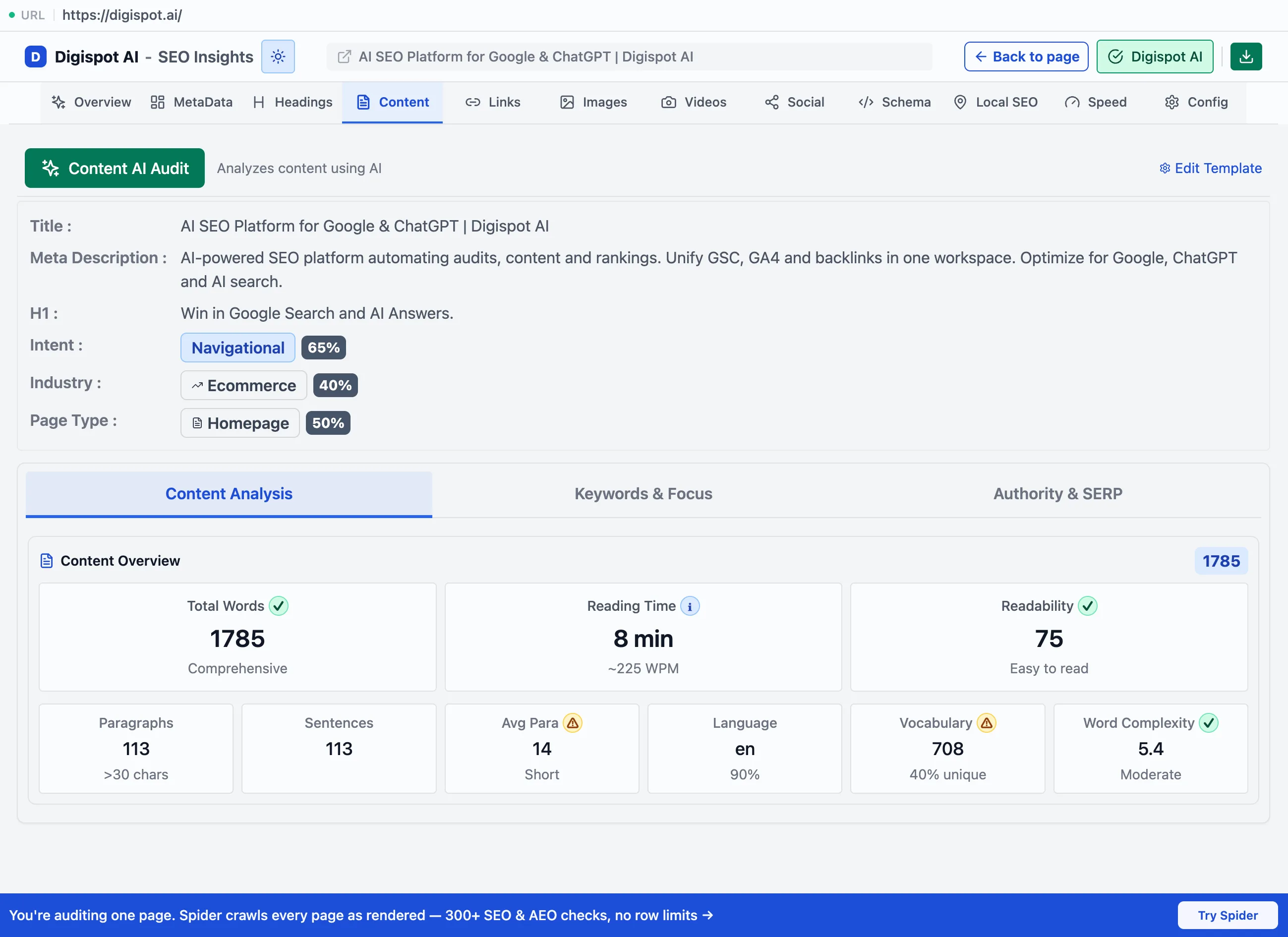
Content analysis
The default sub-tab reports the fundamentals: word count, reading time, readability (Flesch reading ease and grade level), and paragraph and sentence metrics. It then grades the page against the length bands below.
| Band | Word count | What it means |
|---|---|---|
| Extremely thin | under 100 | Flagged as Critical: Extremely thin content — too little text to establish topical relevance |
| Thin | under 300 | Flagged as Warning: Thin content detected — usually below what ranks for a competitive query |
| Adequate | 300–600 | Passes the minimum, but often short of the depth top results carry |
| Optimal | 600–2,500 | The target range for most informational and commercial pages |
| Long | over 5,000 | Long-form; check that it stays focused rather than padded |
Word count is not a ranking factor on its own. The goal is enough depth to cover the topic. Use the flags to spot pages too thin to compete. Then add the sections, examples, and answers a searcher expects, rather than padding to hit a number.
Readability reports the Flesch reading ease score and its grade level. A lower grade level (roughly grade 8–10 for a general audience) widens the readership. Very high grade levels signal dense sentences worth breaking up.
Keywords & focus
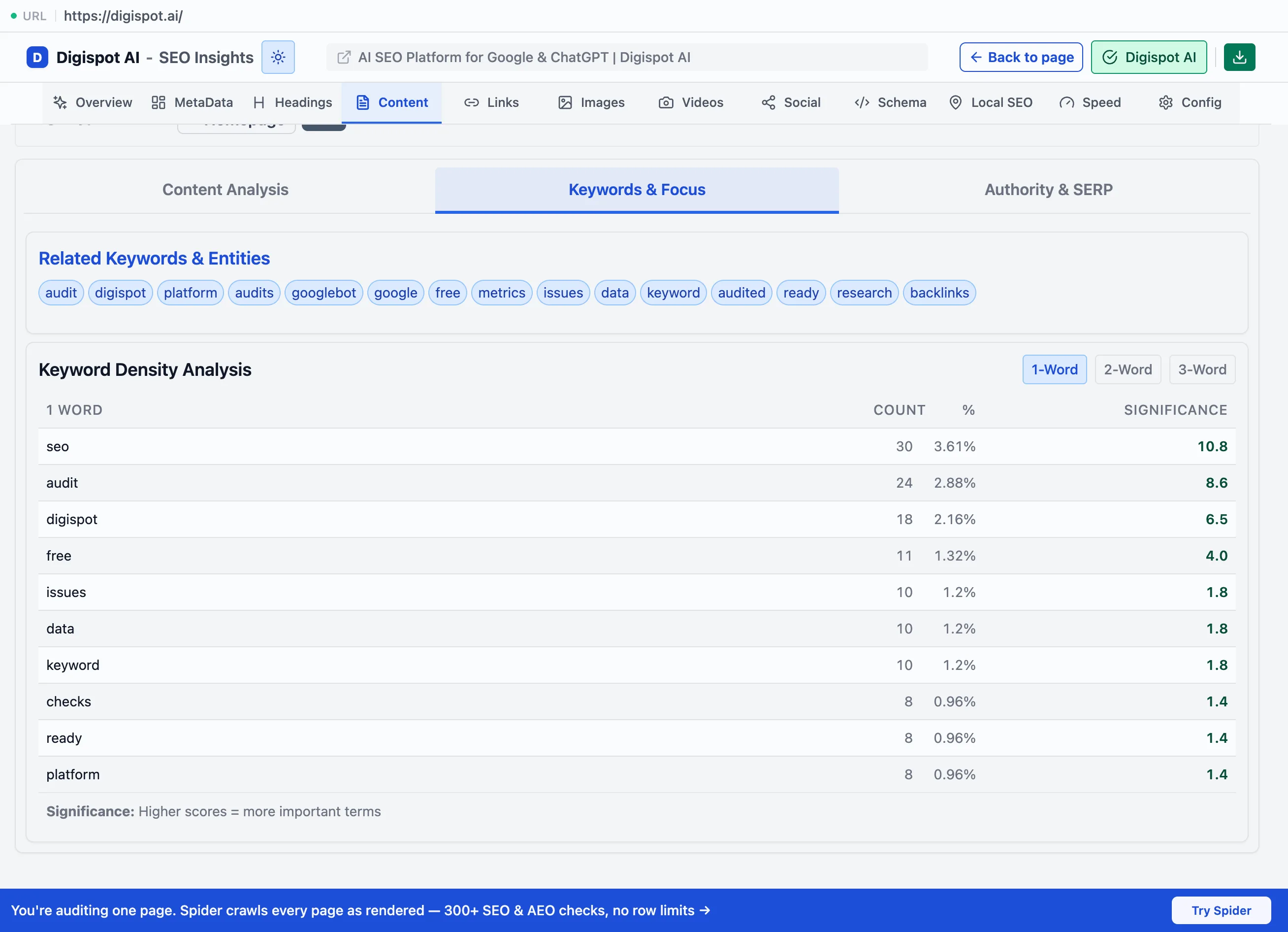
The second sub-tab surfaces what the page is about. This makes any mismatch between the intended topic and the terms actually emphasized visible.
- Industry detection — primary and secondary industries with a confidence score
- Focus keywords — target terms pulled from the title, URL, headings, and meta
- Content relevance — n-gram analysis toggled between unigrams, bigrams, and trigrams, with frequency, relevance, and density
- Related keywords & entities — business entities, people, and locations
Keyword density has its own dedicated panel with deeper analysis. See Keywords.
Authority & SERP
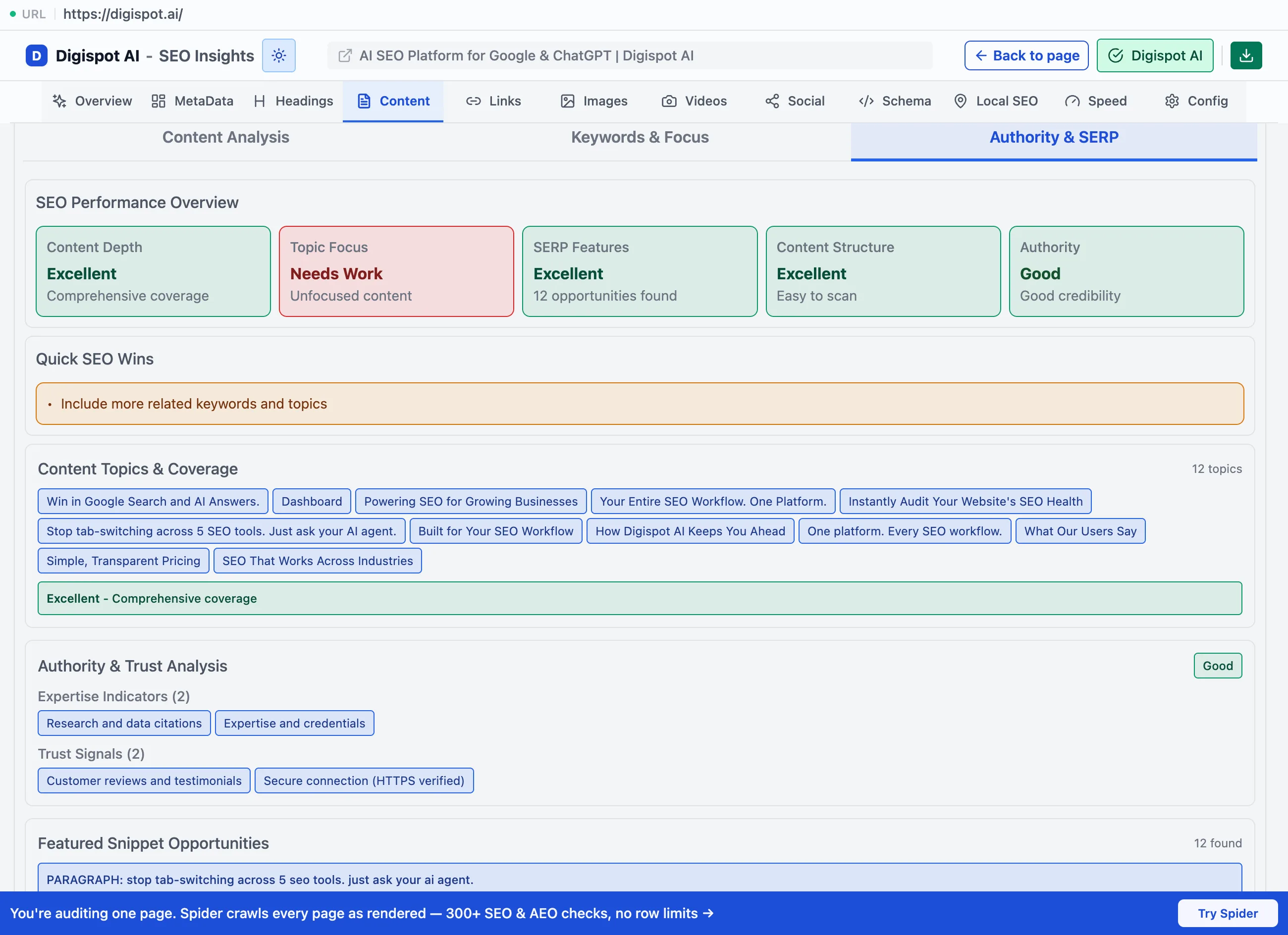
The third sub-tab covers trust and ranking potential. These are the signals that decide whether a page is treated as a credible answer, not just a relevant one.
- Performance metric cards — a snapshot of the page's content scores
- Content topics & coverage — the subtopics the page addresses versus those a query typically expects, so gaps are visible
- Authority & trust — an E-E-A-T assessment (experience, expertise, authoritativeness, trust) that flags missing author, source, or credibility signals
- Featured-snippet opportunities — passages structured well enough to win a snippet, and how to tighten them
Work the sub-tabs in order. Fix length and readability first (Content analysis). Next, confirm the page targets the right terms (Keywords & focus). Then close topic and trust gaps (Authority & SERP). Adding depth to a page that already targets the wrong topic wastes the effort.
Metadata
The Metadata panel audits the title, description, and technical tags that decide how a page is indexed and shown in search results.
Keywords
The keyword analysis surfaces the terms a page ranks for — density across one-, two-, and three-word phrases, related entities, and authority correlation.