
Crawlability report
The Crawlability report checks canonical URLs, meta robots, and whether AI crawlers see the same page Googlebot does.
The Crawlability report answers a single question in three parts. Can search
engines and AI crawlers reach and index a page? And do they all see the same thing
when they do? It is the first report to check when a page has good content but no
visibility, because a wrong canonical or a stray noindex suppresses everything
downstream of it.
Score and bands
The report opens with a crawlability score and its distribution across pages. The per-page gauge reads the score into a plain label:
| Band | Score |
|---|---|
| Excellent | 85–100 |
| Good | 70–84 |
| Needs improvement | 50–69 |
| Critical | 0–49 |
What it checks
The report splits into three tabs, each isolating one crawl signal.
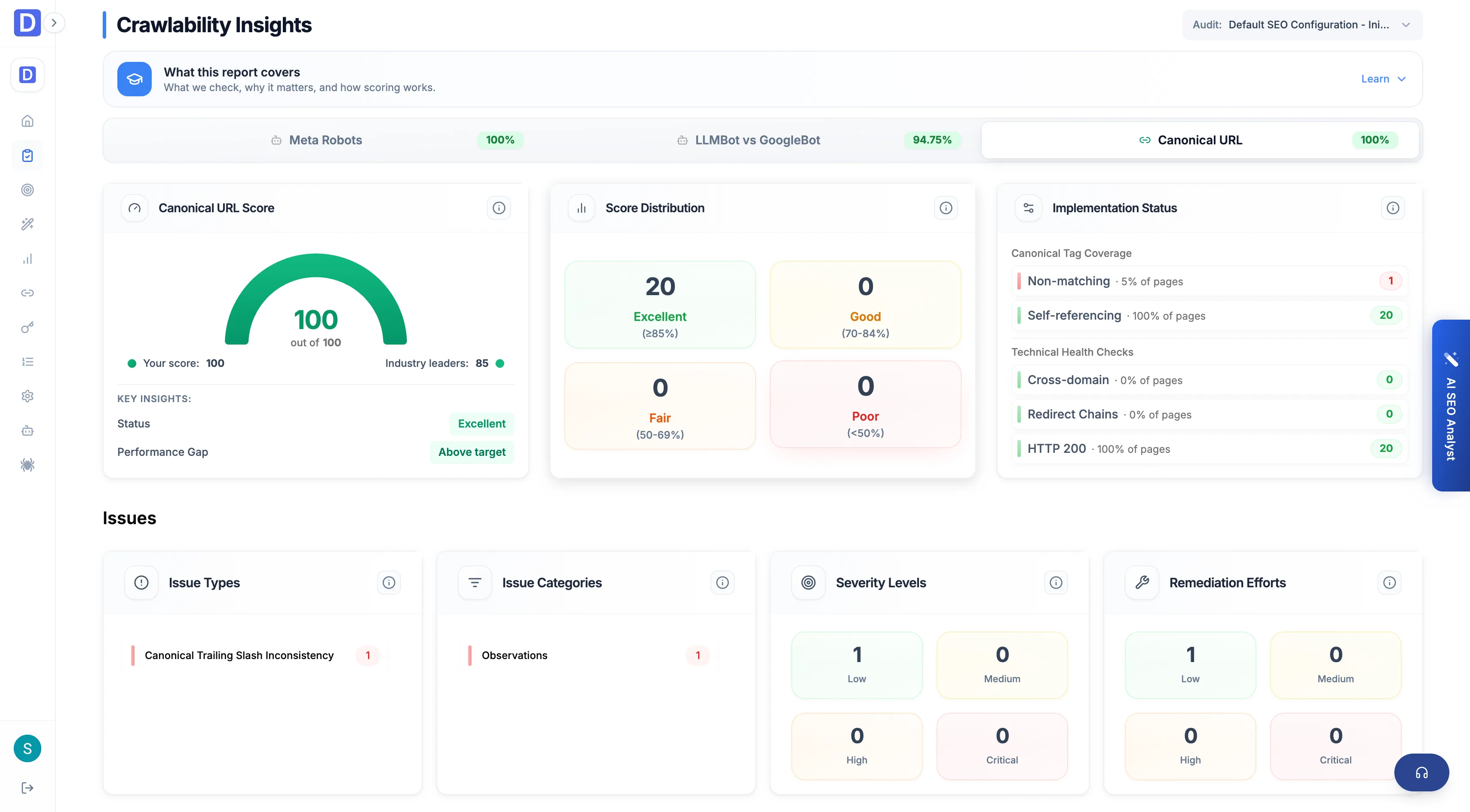
Canonical URL
Whether each page's canonical is self-referencing (the healthy default), cross-domain, or non-matching. It also flags redirect chains and whether the canonical target returns HTTP 200. A canonical pointing at a redirect or a 404 quietly drops the page from the index.
Meta robots
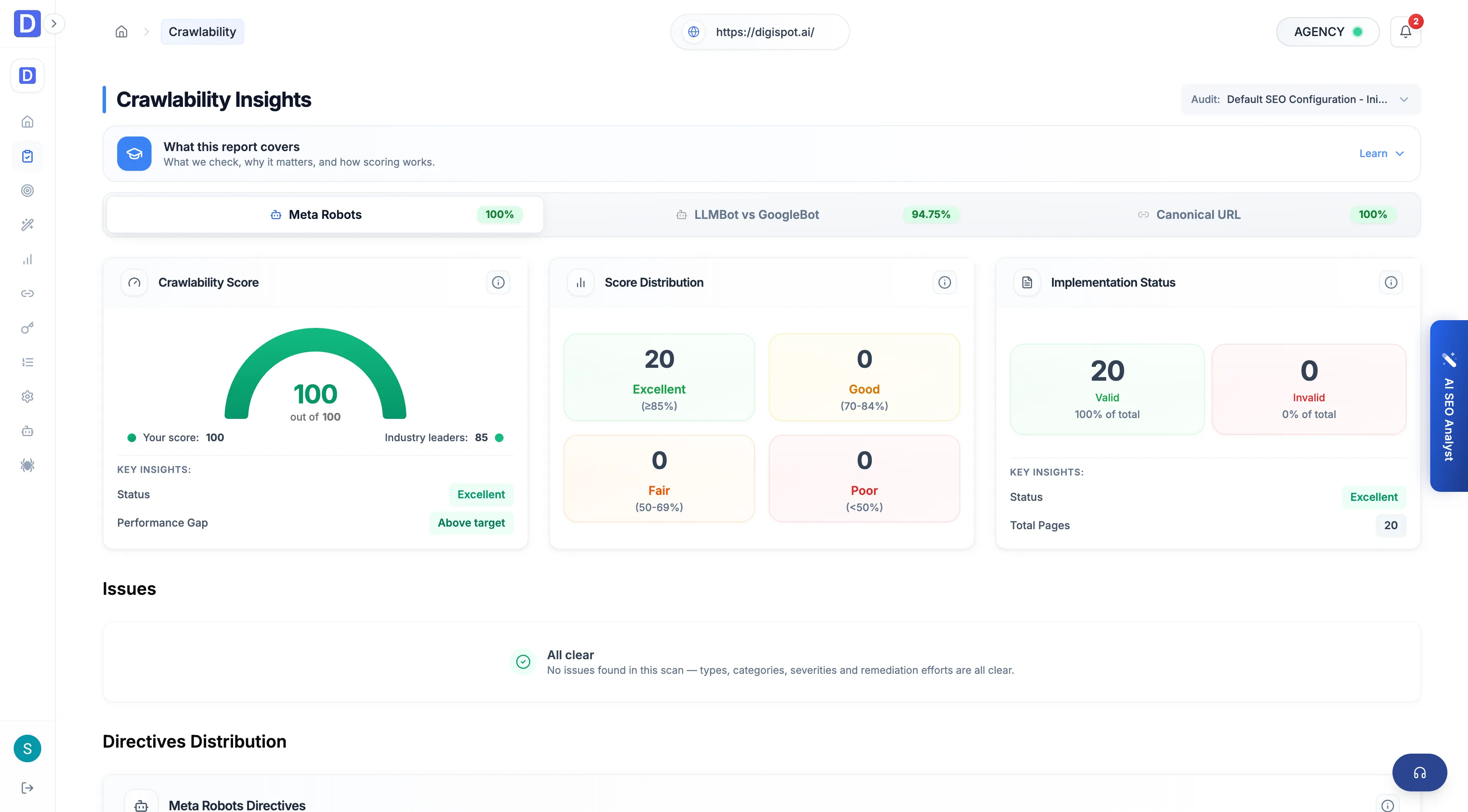
The indexing and following directives declared per page (index/noindex,
follow/nofollow), so an unintended noindex is caught before it costs
rankings.
LLM vs Googlebot
A crawler-consistency score comparing what an AI crawler renders against what Googlebot sees. It reports content-length variance, navigation and schema consistency, and any schema present on one side but missing from the other. Divergence here means JavaScript-dependent content that AI answer engines never receive.
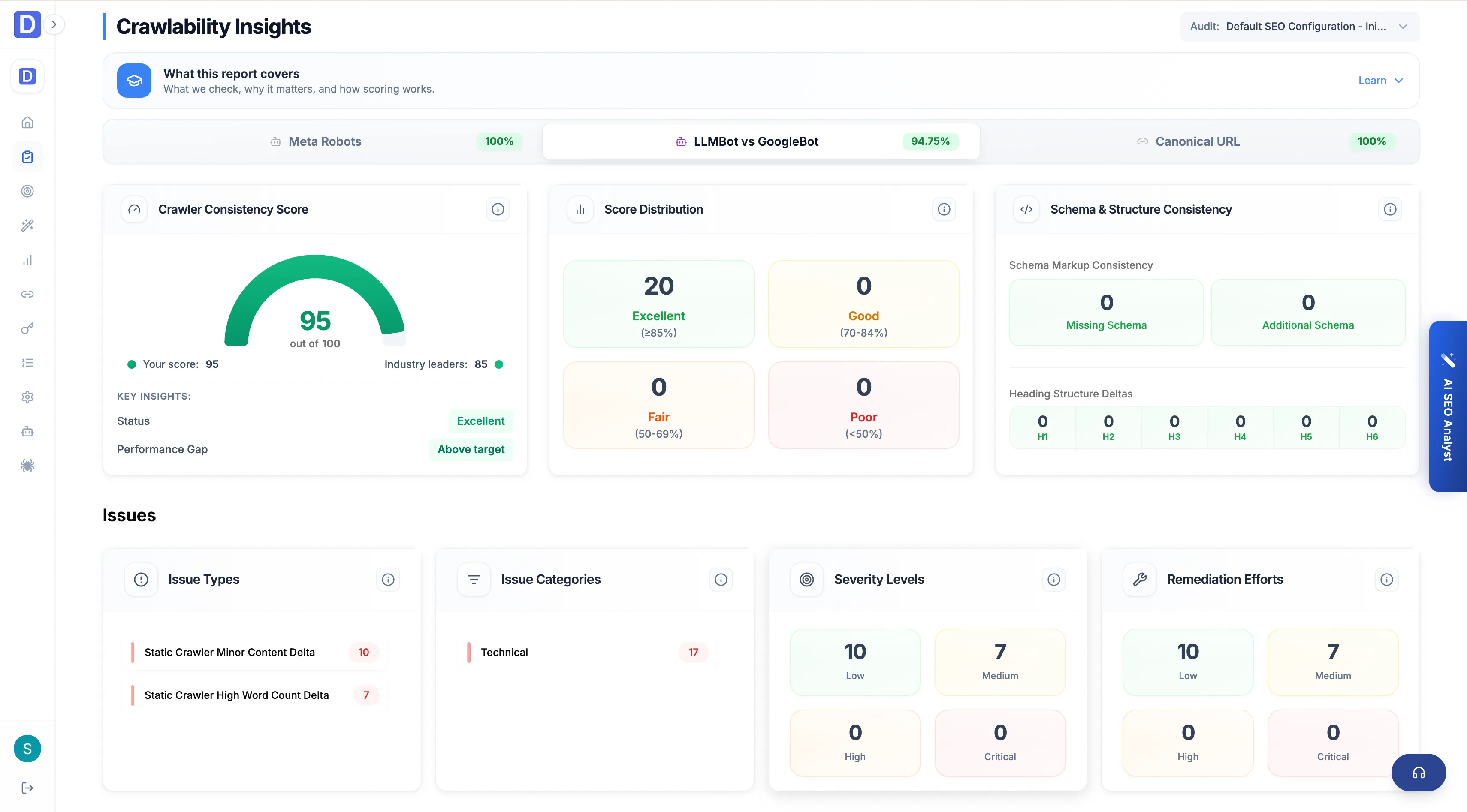
The LLM vs Googlebot tab is increasingly load-bearing. A page that renders fully for Googlebot but ships a thin or schema-stripped version to AI crawlers can rank in Google yet be invisible in ChatGPT, Perplexity, and Gemini answers.
Each tab carries an understanding guide that covers what it is, what's checked, why it matters, and how to improve. Each also carries an AI insight that reads the findings back as next steps.